
A 1958 Design Book Stands the Test of Time
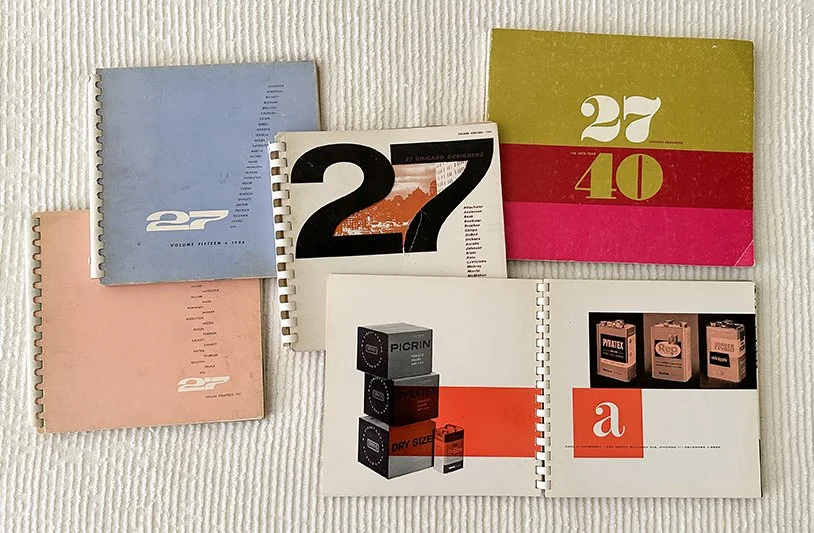
Vintage 27 Chicago books
Updated August 2026
Looking back at a 1958 design book, 27 Chicago, reminded me that good design principles really don’t change much. The technology changes. The styles change. The tools change. But designers are still solving problems for clients and communicating with an audience.
What was 27 Chicago?
27 Chicago was a series of self-promotional books that predated today’s design source books and directories. The 1958 spiral-bound volume featured 27 Chicago designers, illustrators, and typographers. Art directors and art buyers were the target audience.
I inherited five volumes from my dad when he cleaned out his office many years ago. Each book is a wonderful collection of vintage graphic design.
Each designer received four pages. The right-hand page served as an opening or teaser. The following two-page spread showcased the designer’s work and included contact information. The fourth page was blank except for photography and printing credits.
Although the artwork looks dated to us now, many of the designers were remarkably expressive. I also enjoy seeing design choices that have come back into fashion, such as the use of lowercase typography.
Here are a few of my favorites.
“many hats…one head”
This was the headline on the opening page, using a combination of upper- and lowercase typography.
“A designer wears many hats; one day that of a specialist in packaging; the next that of an expert in corporate identity; then the one of a designer of printing, or books, or annual reports, or exhibitions. Each of these activities is based upon the same talent—the ability to see a problem in relation to a client’s needs, and to solve it in terms meaningful to the public.”
—Bruce Beck Design
That description could have been written today. Designers still wear many hats, and the ability to understand a client’s problem and communicate effectively remains at the heart of good design.
“clients like to bring their problems here”
“people who want to sell goods like to work with designers who know marketing…that’s why they come to 646 no. michigan ave”
—Charles Bracken
I love this one, including the original lowercase typography and punctuation.
The message is also remarkably current: clients don’t necessarily need someone who can simply make something look good. They need a designer who understands what they’re trying to accomplish.
Good graphics must speak for themselves
Larry Klein’s entry makes an especially strong case for thoughtful, problem-solving design. He wrote about the difficulty of finding a designer capable of creating a logical and appropriate solution—and pointed out that no amount of explanation can rescue an unconvincing visual design.
His conclusion still resonates with me: good graphics ultimately must speak for themselves.
He also emphasized the importance of understanding the client’s problem and having direct contact between the designer and client.
That is something I still believe strongly. The more I understand about a client’s goals, audience, and challenges, the better I can design a solution.
“Planning, thinking, solving”
That simple phrase from Franz Altschula may be my favorite of all.
Planning. Thinking. Solving.
That’s still what good design is about.
Today, designers may work in InDesign, Photoshop, Illustrator, Canva, or any number of other tools that didn’t exist in 1958. We design for websites, social media, ebooks, print-on-demand books, and digital publications instead of the media available to those Chicago designers.
But the fundamental job hasn’t changed.
Good design identifies a problem, understands the audience, and finds an effective way to communicate.
That’s why a 1958 design book can still have something to teach us.
By the way, 27 Chicago continued to be published for decades and ceased publication in 1991. You can also find a 10-minute video about the books online:
Watch the 27 Chicago video on Vimeo
What old design books, advertisements, or examples of graphic design have influenced you? I’d love to hear about them.