
What do authors want to know?
Originally published in 2015. Updated August 2026.
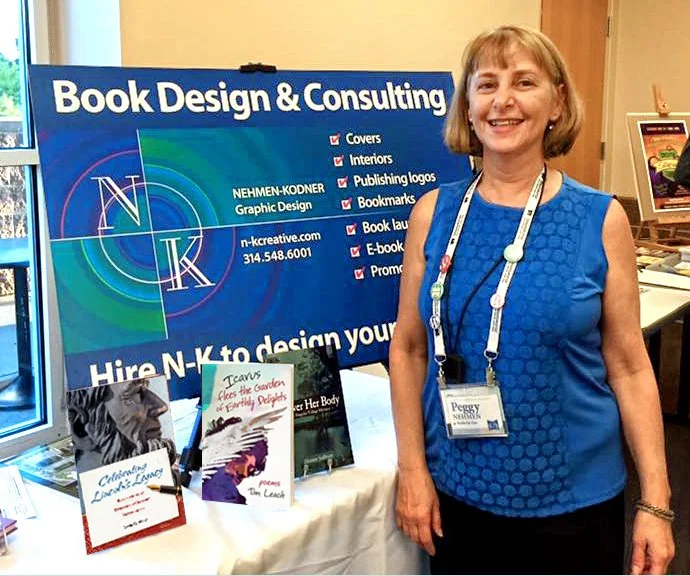
What do authors want to know? At the 2015 St. Louis Publishers Association (SLPA) Vendor’s Showcase, I found out. The room was packed, and authors had plenty of questions. Those who stopped by my table asked about everything from book design and printing to ebooks and book launches.
Many of those questions are still ones I hear from authors today.
Q: What do you do? Authors ask me this all the time. I guess it’s an icebreaker!
A: I design books. That includes book covers, book interiors, typesetting, and production. I also help authors prepare their files for self-publishing and printing.
At the showcase, I pointed to my poster showing the types of books I design and happily showed visitors the book samples at my table. You can see examples of my work in online portfolio.
Q: Can you recommend book-launch ideas?
A: Yes, but I’d like to know more about your book first.
How you launch a book depends on your audience, your budget, the type of book, the venue, and how elaborate you want the event to be. You might have an in-person launch, a virtual event, a bookstore signing, a library presentation, or a broader online marketing campaign.
The important thing is to start thinking about your launch well before your publication date.
Q: Do you design children’s books?
A: Yes.
Children’s books can require a very different approach to design and production than books for adults. I’ve worked on children’s books at various stages, from the concept and design phase to production, where I help authors correct and prepare files for printing.
I’ve also designed bookmarks, postcards, and business cards to help promote children’s books.
Q: What is production?
A: Production is the technical side of getting a book ready for printing after the design stage.
For example, a cover may look fine on screen but need adjustments before it can be sent to the printer. Images may need to be corrected, fonts checked, margins and bleeds verified, and the entire file prepared according to the printer’s specifications.
Good production work helps prevent unpleasant surprises when you receive your printed book.
Q: How much does a book cover cost?
A: It depends on the project.
The cost of a book cover can vary based on the complexity of the design, whether you have an image or illustration to work with, whether stock photography or other licensed artwork is needed, and whether you need additional versions for different formats.
I’m happy to talk with you about your project and explain what’s involved before you make a decision.
Q: Can you design books with glossy paper in the middle for photos?
A: It depends on your printer and the type of book you’re producing.
If you’re publishing through a print-on-demand service, your paper and printing options are determined by the service’s available specifications. You do not have the flexibility to mix different paper stocks within one book.
If your book includes photographs, it’s also important to prepare those images properly before they go into the book. Photos may need to be brightened, color-corrected, sharpened, or otherwise adjusted for print.
Q: Do you do ebook formatting?
A: I can help you prepare your manuscript for an ebook and explain what’s involved.
Ebooks are different from print books. Instead of designing every page to look exactly the same, an ebook needs to be properly structured so the content can reflow on different screen sizes and devices.
I can help you understand the requirements and prepare your files, although I don’t specialize in coding EPUB files from scratch.
Q: When does the designer get involved?
A: Generally, after your manuscript has been copyedited and is close to its final form.
However, I encourage authors to think about design much earlier. Your book cover, in particular, is an important marketing tool, and you can begin working on it well before the book is finished.
If you plan to publish in six months, for example, that doesn’t mean you should wait until the last few weeks to think about your cover.
Q: Do I have to have the inside of the book designed if I only want an ebook?
A: Not in the same way you would for a print book.
An ebook doesn’t have fixed pages in the same way a printed book does. The text can change based on the reader’s device, screen size, and font settings.
You still need a properly formatted and structured manuscript, however. Simply uploading a Word document without preparing it can result in an ebook that looks unprofessional.
Q: Why do I need an ebook if I want to print my book?
A: You don’t necessarily need one, but an ebook can give your book another way to reach readers.
Some readers prefer print books. Others read almost exclusively on phones, tablets, e-readers, or computers. Offering your book in both formats can make it accessible to a broader audience.
Whether an ebook makes sense for your particular book depends on your audience, budget, and publishing goals.
Q: Where can I find local resources?
A: Organizations such as the St. Louis Publishers Association are a great place to start.
The SLPA Vendor’s Showcase was a perfect example. Authors could meet editors, designers, publishers, marketers, printers, and other publishing professionals in one place.
Attending publishing events and connecting with other authors can also help you build a network of people who understand what you’re going through.
Authors Have Questions. That’s a Good Thing.
Self-publishing involves a lot of decisions, and you don’t have to figure everything out by yourself.
Whether you’re publishing your first book or your tenth, it helps to have someone who understands the design and production side of publishing. I can help you understand what needs to happen, when it needs to happen, and how the pieces fit together.
Have a question about your book? Let’s talk. I offer a free one-hour consultation for authors and publishers.
And the SLPA Vendor Showcase is still going strong. The next Vendor Showcase will be held September 9, 2026. It’s an annual opportunity for authors to meet publishing professionals and get answers to their questions about editing, design, marketing, printing, and more. If you’re an author looking for local resources, it’s a great place to start.