
How Professional Book Design Improved This Children’s Book
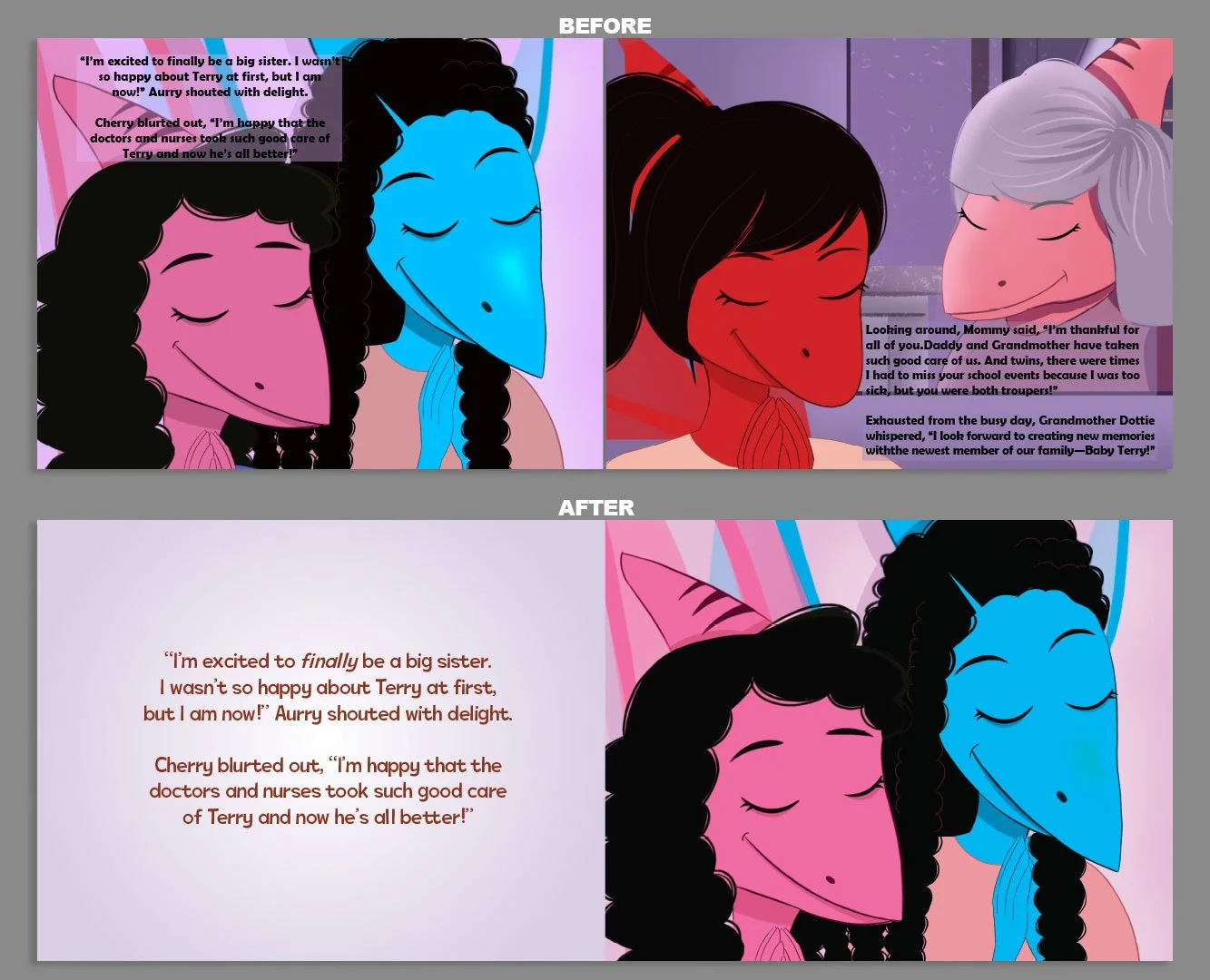
Before (top): Text placed over busy illustrations. After (bottom): A redesigned layout with improved typography, page flow, and readability for young readers.
Why you need a book designer for your children’s book
Publishing a children’s book? Use a book designer to make it visually appealing and easy to read before the artwork begins.
Case study: Channon, a first-time author, hired an illustrator who had little knowledge of book design. How did I know?
1) The artist/illustrator (?) did not leave adequate space for the story paragraphs. There should have been a clear open space for the text. Instead, the typography was poorly placed and hard to read on top of the artwork.
Solution: A book designer would have indicated an area for text on each page. This should been done at the preliminary storyboard phase.
2) Channon and her artist initially sent me a PDF that did not include the inside front or inside back cover; both are blank and do not have page numbers. Thus, in the PDF, the title page was on the left; it should have been a right-hand page.
Solution: A book designer knows the correct page flow and could have avoided this problem at the outset.
3) The artist didn’t understand how to draw in page spreads (left-and-right facing pages). Example: left-and-right facing illustrations were separate, visually too busy, and unbalanced.
Solution: A book designer can help the illustrator with suggestions for balance within the page layout.
4) Some of the illustrations did not leave adequate margins, usually called a safety area. Important parts of the illustration (such as the top of the character’s head) were placed too close to the trim edge.
Solution: A book designer provides guidelines, showing the safety area and trim before the artwork begins.
5) The artist did not send layered files in case I needed to make adjustments.
Solution: The author, illustrator, and designer should discuss the parameters of the project in advance, so they know what type of file format is needed. Ditto for number 6.
6) The artist embedded the images in an Adobe Illustrator file vs. sending individual high-res JPEGs. It would not be good use of my time to copy and paste each drawing into separate files. Adobe Illustrator is great for illustration but not the right program for book layout.
Solution: A book designer would request single files (which I did immediately).
The before-and-after layouts below show how thoughtful book design improved both readability and the visual balance of the story.
The Outcome
My solution to numbers 1 and 3: To improve the story’s typography, I placed the text on the left-hand page and the artwork on the right-hand page. (I deleted all text on the right-hand-page illustrations.) I increased the point size, used a kid-friendly typeface, and added a soft, pastel background tint to blend with the artwork. Now, the story was easy to read.
The new layout added more pages to the book. It went from twenty-four pages to thirty-two pages – the standard page count for children’s books. The author said, “I was initially shocked by the number of pages, but this layout provides greater readability.”
Mistakes like these can be avoided when the author, illustrator, and book designer plan the project together before the illustrator begins creating the artwork. Early collaboration leads to a children's book that's visually engaging, easy to read, and professionally produced.
If you’re planning to publish a children’s book, I’d be happy to help you get started. Schedule a free one-hour consultation, and together we’ll create a plan that saves time, avoids costly revisions, and gives your story the professional presentation it deserves.
If you’re just getting started, you may also enjoy reading Guiding Authors Through the Book Design Process, where I explain how I work with authors from concept to publication.