
Before Your Book Designer Starts: Decisions Every Author Must Make
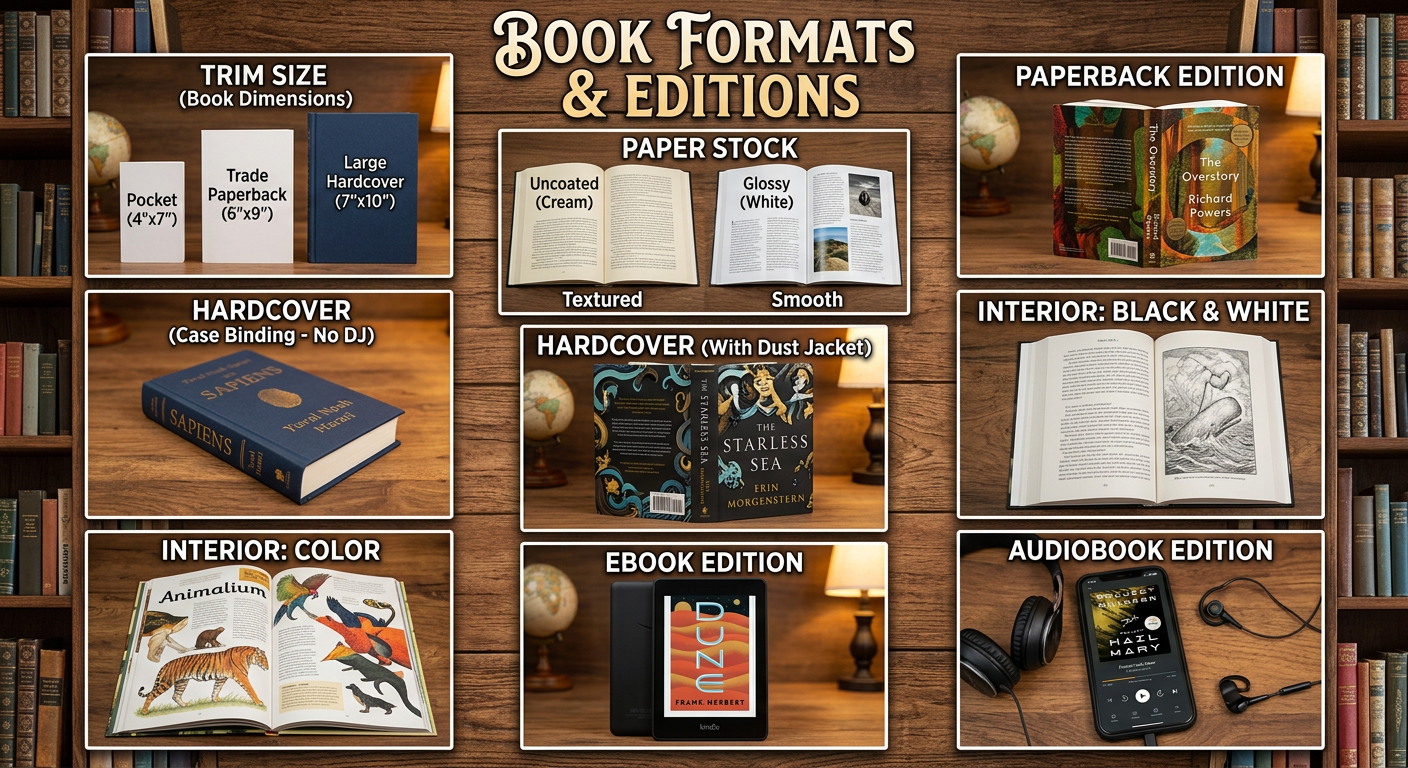
Many first-time authors come to a designer asking for a book cover. That’s a great place to start—but before the final cover can be created, several publishing decisions need to be made.
Trim size, paper stock, binding options, ebook editions, audiobooks, and distribution channels all affect the design process. Understanding an author’s publishing goals helps ensure an accurate estimate and a smoother production process.
Decisions to Make Before Design Begins
Before the design process starts, authors should consider:
Book size (trim size)
Paper stock
Paperback edition
Hardcover edition (without dust jacket)
Hardcover edition (with dust jacket)
Black-and-white or color interior
Ebook edition
Audiobook edition
Each format has different specifications and production requirements.
For example, ebooks and audiobooks require separate cover files. Ebook covers are typically 1600–2560 pixels on the longest side, depending on the retailer. Audiobook covers are square and generally require a 2400 x 2400 pixel format. Always check the specifications of the company distributing your book.
What If You Don’t Know Yet?
Many first-time authors aren’t sure what formats they want when they begin the publishing process—and that’s completely understandable.
An author may know they want a paperback but haven’t considered whether they will also need a hardcover, ebook, audiobook, or distribution through multiple print-on-demand companies. Those decisions often evolve as authors learn more about publishing.
That’s why designers ask questions early in the process. The goal isn’t to overwhelm authors with technical details, but to understand their publishing goals and provide an accurate estimate.
If you’re uncertain, say so. It’s much easier to discuss options and plan for future formats at the beginning of a project than to discover additional requirements after production is underway.
The more information a designer has about your goals—even if some decisions are still pending—the better they can guide you through the process and prepare an estimate that reflects the work involved.
Choosing a Print Size
One of the first decisions an author must make is the trim size of the book.
The best way to determine an appropriate size is to research comparable titles (often called “comp titles”) within your genre. What sizes are commonly used by books similar to yours?
For example, early in the design process, memoir author Jim Laurie selected a 5.5" x 8.5" trim size, a common format for memoirs. Once that decision was made, I could begin designing cover ideas.
Why These Decisions Matter
The book’s specifications affect every stage of production.
The two largest print-on-demand (POD) providers, KDP and IngramSpark, use similar—but not identical—cover measurements and templates.
One significant difference is spine width. Although the cover artwork may remain the same, each company calculates spine width differently. As a result, separate cover files must often be created for each platform.
This is why the interior layout must be finalized before the cover can be completed.
How Spine Width Is Determined
A book’s spine width is based primarily on:
Total page count
Paper type
Binding style
The page count includes all front matter and back matter. Because of this, the manuscript must be fully edited, formatted, and approved before final cover production can begin.
Paper stock also affects spine width. For most nonfiction books, novels, and memoirs, I typically recommend 70 lb. white paper. However, authors should research their options, review samples when possible, and verify available paper stocks with their chosen POD provider before making a final decision.
Using Cover Templates
Fortunately, neither KDP nor IngramSpark requires designers to guess.
Both companies provide cover calculators and downloadable templates. These templates are generated using specific information about your book, including:
Binding type
Interior type
Paper stock
Trim size
Final page count
Once these details are confirmed, accurate cover templates can be created.
A Real-World Example
Author Jose Campos chose to publish through both KDP and IngramSpark.
His project required:
Hardcover cover for KDP
Hardcover cover for IngramSpark
Paperback cover for KDP
Paperback cover for IngramSpark
One interior file used for both print editions
One ebook cover
One audiobook cover
In total, I created seven project folders—one for each format and platform. Organizing files this way prevents confusion and makes future updates much easier.
I also recommend including the platform name in every file name. For example:
BookTitle_KDP_Paperback.pdf
BookTitle_IS_Hardcover.pdf
BookTitle_Ebook.jpg
Clear organization saves time and helps avoid costly publishing mistakes.
Final Thoughts
Many authors think a book cover is the first step in the design process. In reality, several important publishing decisions must be made before cover production can be finalized.
Trim size, paper stock, binding type, page count, and distribution channels all affect the final files. The more decisions an author makes upfront, the smoother the design and production process will be.
A designer isn’t just creating a book cover; they're helping authors navigate dozens of publishing decisions that affect the final product.
Planning a book project?
Whether you’re publishing a memoir, novel, children’s book, or nonfiction title, the decisions you make early in the process affect everything from your book’s design to its production costs and distribution options.
If you’re not sure where to start, I can help. Together, we’ll determine the best format, trim size, and production path for your book—and create a professional design that supports your publishing goals.