
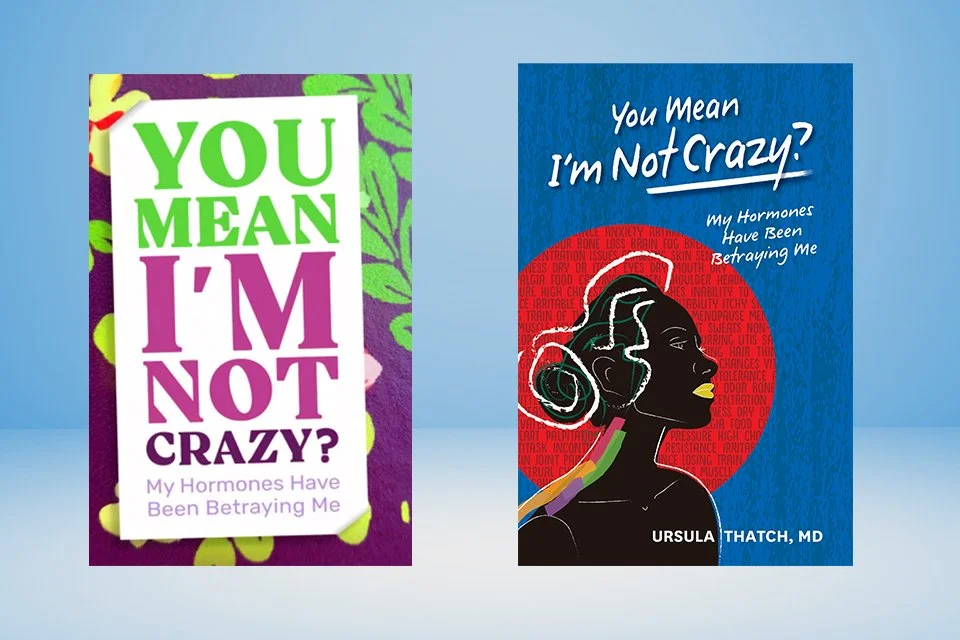
Before and after: Two different design approaches. Through collaboration and a fresh perspective, the final cover evolved into a visual story that captures the emotional experience of menopause.
A call from book coach Jo Lena Johnson led to an interesting project. She needed help designing a book cover and wanted a woman’s perspective and style instead of her usual designer—a man she had worked with for years.
Both covers (shown above) communicate the title, but in different ways. The first relies primarily on typography. The final cover uses illustration as a visual metaphor, incorporating the list of menopause symptoms into the artwork itself. It's a good example of how imagery can add another layer of meaning to a book cover.
Topic: Menopause
Title: You Mean I’m Not Crazy
Subtitle: My Hormones Have Been Betraying Me
The Challenge
Jo Lena’s creative brief stated:
“Our concept is: Words to include on the book cover are listed below. Please copy and paste these words and spread them in a ‘crazy’ manner on the book cover. (I know, there are 67 words.) Our title is brief, informative, and acknowledges the feelings, challenges, and reasons women often feel ‘crazy’ while offering solutions to change the feelings, reasons, and root causes.”
After reading the brief and speaking with Jo Lena, I searched stock image websites and began creating layouts. One concept included a word cloud—a graphic made entirely of words using the list of menopause symptoms. However, those initial ideas were not what Jo Lena had envisioned.
This project also reminded me of the importance of reviewing image options with a client before investing too much time in layouts. Once JoLena and I looked at stock images together, the right direction became obvious and the design process moved much more efficiently.
During a Zoom meeting, we reviewed additional images on GettyImages.
“Wait, go back. I want to see that image we just passed up.”
An abstract illustration of a woman’s silhouette had caught her attention.
“Can we modify this to include the list of words?”
“Yes,” I replied. “The artwork is vector-based, so I can separate the illustration into layers and incorporate the symptoms into the design.”
A New Direction
With a clear direction established, a new cover design began to take shape.
First, the illustration’s layers needed to be separated to give me greater control over the artwork. Next, the list of symptoms had to be typeset into a block of text and placed inside the red circle behind the woman’s head using a technique called paste inside.
Fortunately, the illustration included an interesting textured background that worked well for extending onto the back cover.
For the title and subtitle, I chose an old favorite typeface called Maxine. Its handwritten style helped express the emotion and sentiment behind the title.
For the remaining text—including the author’s name, endorsements, and back-cover copy—I selected National, a clean sans serif typeface. It is highly readable and works especially well when reversed on a dark background.
Final Cover
The final cover was well received by both Jo Lena and the author, Dr. Ursula Thatch, an OB-GYN.
“Peggy Nehmen listens, draws upon her natural creativity and vast experience—and delivers a finished product in alignment with the concepts we submit. Achieving the “perfect” cover is a unique opportunity because many new writers don’t necessarily know how to express their designs unprompted. The “right” designer can bring our ideas fruition—many times even better than we can imagine! My clients are always pleased with the results, and so am I!”
—Jo Lena Johnson, book coach
Jo Lena has coached hundreds of authors throughout her career, and I was honored to collaborate with her on this project.
Sometimes the best design solution isn't found in the initial brief. It emerges through conversation, exploration, and collaboration—a process that led to a cover both the coach and author enthusiastically embraced.
Every book design project begins with a conversation. Whether you have a clear vision or just a rough idea, working together is often the best way to discover the right direction. If you're looking for an experienced book designer to help bring your book to life, I'd love to hear about your project.